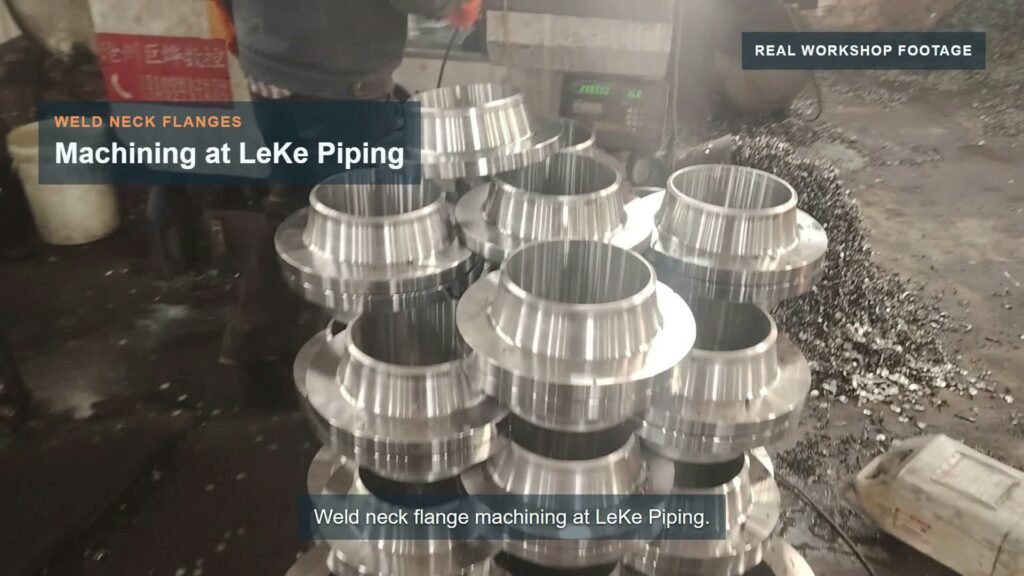
How does a weld neck flange take shape during machining? This short LeKe Piping workshop video follows selected operations, from flange blanks with machining allowance to turning and close-up views of the finished components.
Watch the machining stages
- 00:00: Weld neck flanges, blanks and machining allowance.
- 00:17: Turning the flange face, bore and hub.
- 00:38: Further CNC machining and finished flange features.
- 00:51: Raised face and finished weld neck flanges.
Starting with machining allowance
A flange blank retains material for subsequent machining. In the opening workshop scenes, the blanks are shown before their final features have been developed. The allowance provides material that can be removed as the specified surfaces and dimensions are produced.
The required finished geometry depends on the applicable flange standard and the order drawing. A visual workshop overview does not establish a particular material grade, pressure class or dimensional acceptance result; these details should be confirmed in the purchasing specification and supporting documents.
Turning the flange face, bore and hub
The turning scenes show work on the bore and flange face, followed by further machining of the hub and weld end. These are useful features for a buyer to identify: the bore relates to the pipe connection, while the hub and weld end form the transition towards the adjoining pipe.
When requesting a quotation, provide the required bore or pipe wall thickness alongside the nominal size. Where a project drawing defines additional geometry or preparation details, include it with the enquiry so that these requirements can be reviewed together.
Raised face and finished flange features
Later views show the raised face and machined surface, together with the hub, bore and bolt hole arrangement on finished flanges. The CNC close-up shows a further machining operation; the finished-component views provide the separate view of the bolt hole pattern.
Specify the required facing and any surface-finish requirements in the order. If your project calls for particular dimensional checks, material documentation or additional inspection, state these requirements before production is agreed.
What to include in a weld neck flange enquiry
A clear specification helps us review the required component and prepare a relevant response. Please include:
- Applicable flange standard and edition, where specified.
- Material specification and grade.
- Nominal size and pressure class or rating designation.
- Bore or connecting pipe wall thickness.
- Facing type and any specified surface finish.
- Quantity and delivery requirements.
- Drawings, special tolerances, documentation and inspection requirements.
If a requirement has not yet been decided, identify it in your enquiry rather than leaving it implicit. This makes it easier to clarify the scope before an order is placed.
Discuss your flange requirements with LeKe Piping
Review our weld neck flange product page for the component overview, or learn more about LeKe Piping.
To discuss a specific requirement, send your drawing or specification or email info@lkpiping.com.